

[Global Food Packaging News] With the advancement of the global "carbon neutrality" goals, stricter food safety regulations, and the refined development of the snack industry, the market for food-grade roll films has entered a period of high-quality growth. Among them, eco-friendly packaging solutions, peanut snack roll films, and food grade roll films have seen continuous explosive demand, becoming the core driving force for industry growth. According to a report by Global Industry Analysts, the global market for food preservation films (roll films) will steadily expand by 2025, and is expected to reach 15.1 billion US dollars by 2030, with a compound annual growth rate of 5.9%. The demand for peanut snack and other nut-specific roll films has grown at a rate exceeding 18%. China, with its well-developed industrial chain advantages, core technological innovations, and strict compliance control, has become a core supplier of food-grade roll films globally. The export volume of the three categories has increased by 50% year-on-year, and the products are exported to major markets such as Europe, the United States, Japan, South Korea, and Southeast Asia, demonstrating strong foreign trade competitiveness.
Multi-dimensional compliance certification strengthens the entry barriers for food-grade film exports in the foreign market
Food-grade roll film, as the core packaging material in direct contact with food, has extremely strict requirements for food safety, environmental protection performance and compliance certifications. Especially in the current era where green trade barriers are increasingly prominent, a complete certification system has become a "hard currency" for product export. Chinese enterprises have deeply focused on compliance issues and have built a comprehensive certification system, precisely adapting to different overseas market regulatory requirements. They have successfully broken through international technical barriers and laid a solid foundation for the export of food-grade roll film, peanut snack-specific roll film and environmental packaging solutions.
Currently, all product series have fully met the mainstream standards of both domestic and international markets: Food-grade roll film strictly follows the safety requirements of China's GB 4806.7-2016, while also conforming to the degradable standards of the EU EN 13432, the certification norms of the US ASTM D6400 and the Japanese JIS K 6953 standards; Peanut snack roll film has additionally passed special tests for nut packaging to ensure no odor, prevention of oil penetration, and complete adaptation to the storage characteristics of peanut snacks. In terms of certification, all product series have passed ISO 9001 quality system certification, ISO 22000 food safety management system certification and BRC food packaging material certification. The special supply version for the North American market has obtained the FDA food contact safety certification (in compliance with 21 CFR Part 177.1520 standards), and the products for the EU market have passed REACH regulations (covering 224 SVHC high-priority substances) and RoHS requirements. Some environmentally friendly versions have passed the GRS global recycling standard certification. Each batch of products provides complete test reports and certification documents, providing comprehensive support for overseas customers' customs clearance and market promotion.
Food Grade Roll Film: Guarding the Bottom Line of Food Safety with Stringent Standards
Food grade roll film (food-grade roll film) is positioned with the core characteristics of "safe and non-toxic, weather-resistant and durable, and suitable for various scenarios". It is the core packaging material for snacks, fresh produce, and pre-prepared foods, and has become the preferred choice for global food enterprises due to its excellent barrier properties and safety. Chinese enterprises focus on upgrading the core technology of food-grade roll film, overcoming industry pain points such as material compatibility and performance optimization, and creating high-quality products that are both safe and practical, covering both mid-to-high-end and mass markets.
In terms of material selection, they strictly select environmentally friendly materials such as food-grade virgin PE, PET, and PLA, and prohibit the use of toxic and harmful additives. This ensures that the materials are safe, non-toxic, and free of harmful migration, with volatile substance content ≤ 0.5%, fully meeting the requirements for direct food contact. In terms of production processes, they adopt environmentally friendly technologies such as low-temperature blow molding and solvent-free bonding, significantly reducing energy consumption and carbon emissions. Compared to traditional processes, energy consumption is reduced by more than 30%, and there is no VOCs (volatile organic compounds) emission, aligning with the global trend of low-carbon production. The product performance has been comprehensively upgraded, with tensile strength exceeding 15 MPa, excellent puncture resistance, leakage prevention, and barrier properties. It can effectively block oxygen, moisture, and ultraviolet rays, extending the shelf life of food. At the same time, it supports customized processing such as printing, bonding, and cutting, and can meet the size and appearance requirements of different food packaging. Currently, it has become the core supplier for many small and medium-sized food enterprises and large chain brands worldwide, with export volumes ranking among the top globally.
Peanut Snack Roll Film: Scene Customization to Meet the Exclusive Needs of Peanut Snacks
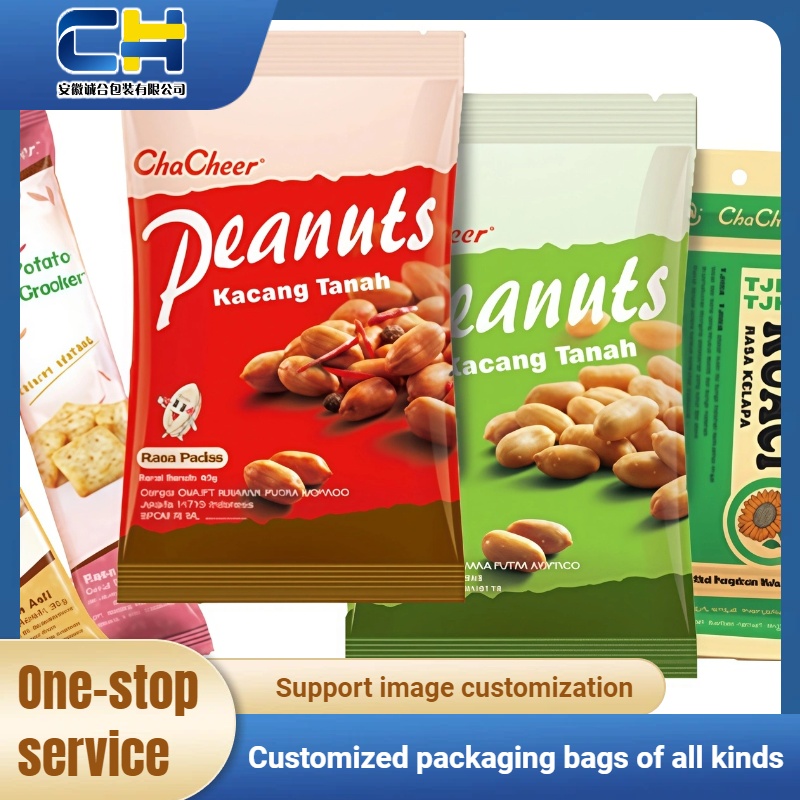
Peanut snack roll film (peanut snack roll film) is a core subcategory of food-grade roll films, specifically tailored for snacks such as peanuts and nuts. It precisely addresses the storage problems of peanuts and snacks, such as moisture absorption, oxidation, oil leakage, and fragility. It strikes a balance between practicality and convenience, becoming the core supporting choice for peanut snack export enterprises. The market demand is continuously rising. Chinese enterprises have deeply explored the packaging scenarios of peanut snacks and combined the processing techniques and consumption habits of peanut snacks in different regions around the world to create customized solutions, demonstrating their differentiated competitive advantages.
The product has been optimized for targeted core performance: it adopts a multi-layer composite structure. The inner layer uses food-grade anti-oil PE material, which effectively prevents the penetration of peanut oil and avoids packaging contamination and adhesion; the middle layer adds a barrier layer to prevent oxygen and moisture, preventing peanuts from absorbing moisture, oxidizing, and deteriorating, and extending the shelf life by up to 12-18 months, ensuring the crispy texture of peanuts; the outer layer uses wear-resistant and printable materials, supporting environmentally friendly ink printing, allowing for custom brand logos, product information, and anti-counterfeiting marks, and is compatible with automatic packaging machines, significantly improving the packaging efficiency of peanut snacks. The design details also take convenience into account, introducing tearable and sealable styles, facilitating consumers' access and storage, while optimizing thickness and toughness, balancing packaging protection and lightweight, and reducing transportation costs. For the European market, an environmentally friendly and degradable peanut snack roll film is launched, aligning with the local environmental consumption trend; for the Southeast Asian market, the heat resistance and moisture resistance are enhanced, suitable for tropical climates; for the Japanese and Korean markets, the printing process and appearance design are optimized to meet local aesthetic needs. Currently, the products have been exported to major peanut snack production and consumption countries such as the United States, India, and Indonesia, with a year-on-year growth of 58% in orders, and have received high recognition from overseas customers.
Eco-Friendly Packaging Solutions: Green Innovation Empowering Industrial Sustainable Development
Eco-friendly packaging solutions rely on the food-grade film and peanut snack film product system, with the core concept of "low carbon, environmental protection, recyclable, and degradable". They provide a one-stop green packaging solution for global food enterprises, aligning with the global "dual carbon" goals and the trend of environmental-friendly packaging, and becoming a new engine for the growth of China's food-grade film exports. Chinese enterprises focus on environmental technology innovation, promoting the green transformation of the packaging industry, taking into account environmental performance, product practicality, and cost controllability, and solving the industry's dilemma of "high pollution and difficult degradation" of traditional packaging.
The solutions cover three core directions: First, degradable packaging solutions, using PLA, PBAT, etc. degradable composite materials to create degradable food-grade films and peanut snack films. Within 180 days in natural environments or industrial composting conditions, the biodegradation rate exceeds 90%, with no residues, fully meeting international degradable standards; Second, recycling and circulation solutions, using recycled PE resin to produce food-grade films, with a recycled content of no less than 20%, certified by the GRS global recycling standard, achieving resource recycling and utilization, reducing carbon footprint by over 30%; Third, low-carbon production solutions, optimizing production processes, using energy-saving equipment, reducing energy consumption and pollutant emissions during the production process, while providing packaging design optimization services to reduce packaging material waste, helping overseas customers achieve sustainable development goals. Currently, this solution has been applied to peanut snack and various food packaging scenarios of international snack brands such as Nestlé and Mondelez, with an order growth rate of 52% in the European market, becoming a core partner for global food enterprises in their green transformation.
Accelerating global expansion and building a comprehensive foreign trade service advantage
With the continuous expansion of the global food-grade film market, Chinese enterprises have been continuously increasing their research and development investment, focusing on technological innovation and product upgrading. They have mainly developed antibacterial, high-barrier, and intelligent environmentally friendly food-grade film products. By adding natural antibacterial components, they enhance the packaging's antibacterial performance, extend the shelf life of food, and further increase the product's added value. At the same time, they continuously expand the global market, focusing on emerging markets such as Latin America and the Middle East. By leveraging the "Belt and Road" initiative and cross-border e-commerce platforms, they expand export channels and enhance the global influence of Chinese food-grade films.
Relying on a complete foreign trade service system, Chinese enterprises have established overseas warehousing and service centers in Germany, the United States, and Singapore. Commonly used food-grade film and peanut snack film products are delivered locally within 72 hours. The delivery cycle for customized products is controlled within 15 days, significantly improving delivery efficiency. They have also formed a multilingual professional service team to provide a full-process service from product selection, customization design, certification processing to after-sales maintenance, assisting overseas customers in completing customs clearance, certification filing, and other procedures, thereby reducing procurement thresholds and risks. A foreign trade enterprise manager stated that in 2025, the export volume of food-grade films, peanut snack film, and environmental protection packaging solutions will account for 93%. Among them, the European market will account for 41%, the North American market for 36%, and the Southeast Asian market for 17%. In the future, they will continue to deepen academic-industry-research cooperation, overcome technical bottlenecks such as cost control of degradable materials and continuous production, promote product upgrades to high-end, environmentally friendly, and intelligent, and improve the global service network to provide more high-quality customized solutions for overseas customers.
Industry Outlook: Green Compliance Sets the Stage for Transforming the Global Food-grade Film Market
Industry experts have pointed out that the global food-grade film market is accelerating its transformation towards "safety, environmental friendliness, scenario-based, and customized" directions. Food-grade compliance, environmental performance, and scenario adaptability will become the core competitive points. At the same time, the market demand for environmental packaging solutions will continue to explode. According to predictions, the global sustainable food packaging market will grow from 301.8 billion US dollars in 2025 to 530.4 billion US dollars in 2035, with an increase of 75.8%, providing a huge market space for environmentally friendly food-grade films. Chinese enterprises, with their complete industrial chains, core technology accumulation, strict compliance control, and high cost-effectiveness advantages, are expected to increase their global market share of food-grade films to over 50% in the next 3-5 years. Through continuous optimization of product performance, improvement of environmental solutions, and establishment of a global service network, Chinese food-grade films and peanut snack films will transform from "cost-effective suppliers" to "high-end brand leaders", promoting the global food packaging industry to develop in a more green, safer, and more sustainable direction with high quality.


